The ISEE essay is a 30-minute writing sample at the end of the Lower, Middle, and Upper Level tests. It is not scored; a copy goes to the schools your child applies to, and they read it to see how clearly your child writes. The best way to practice is to write timed essays to fresh prompts and get feedback on ideas, organization, voice, and conventions.
Take a free full-length diagnosticLast updated September 27, 2026.
The essay is the last section of the ISEE Lower, Middle, and Upper Level tests. Your child gets one prompt and 30 minutes.
It is not scored. A copy goes to the schools that receive your child's scores, and families do not get a copy.
Schools read it to see how clearly your child expresses ideas, how well they handle grammar and spelling, and what they think and value.
| What to know | |
|---|---|
| Time | 30 minutes, one prompt |
| Levels | Lower, Middle, and Upper (students applying to grades 5 to 12). The Primary Levels have no essay. |
| Where it falls | Last, after the four multiple-choice sections |
| Scored? | No. It is sent to schools without a grade. |
| Who reads it | The schools that receive your child's scores. Families do not receive a copy. |
| Typed or handwritten | Typed on the online test. Handwritten in black or blue ballpoint pen on the paper test. |
| Prompt style | One or two sentences, written for the student's grade level, about the student, their community, or the world |
Sources: ERB's ISEE overview for families, ERB's What Is the ISEE? article, and ERB's What to Expect on the ISEE guide (Upper Level).
ERB's What to Expect guide describes each prompt as one or two sentences long and written for the student's grade level. A prompt may ask about the student, their community, or the world in general, and it asks the student to respond to the situation it describes. The prompts change during the testing season, so there is no way to know the topic ahead of time.
In practice, that means your child should be ready for two kinds of prompts: a personal one (tell about a time, a person, or a place) and an opinion one (take a side and support it). Younger students tend to see more personal prompts. Older students should expect more prompts that ask for a position and reasons.
It depends on the test format. On the online ISEE, whether at a test center or at home, students type the essay. ERB's at-home proctor guide notes that spell check is built into the online essay. On the paper ISEE, students write the essay by hand. Find out which format your child is taking when you register at iseetest.org, and practice the same way. Try this: if the test is on paper, write at least two practice essays by hand with a timer, so your child learns how much fits in 30 minutes.
Because the essay is not scored, each school reads it in its own way. ERB's guidance says schools use it to see how clearly a student expresses ideas, their grammar and spelling, and their thoughts and values. Schools may also compare it with other writing in the application to confirm that the student wrote their own materials. Four things make an essay easy to read well:
An essay does not need to be long or fancy. A short essay with one clear example usually reads better than a long one that wanders.
| Minutes | Step | What to do |
|---|---|---|
| 0 to 5 | Plan | Read the prompt twice. Write your main point in one sentence. List one or two examples you can describe in detail. |
| 5 to 25 | Write | Open with your point. Give each example its own paragraph. End by saying what the examples show. |
| 25 to 30 | Check | Reread from the start. Fix missing words, spelling, and sentences that run together. |
Three to five paragraphs is a comfortable size for most students in 30 minutes. Lower Level students may write three shorter paragraphs; Upper Level students can often write four or five. For how the essay fits into the whole test day, see the ISEE timing and pacing guide. Try this: set a timer for 5 minutes, read one of the prompts below, and write only the plan. Do this with three prompts, then write one full essay from the plan you like best.
These prompts were written for ISEE Coach. They are not from any ISEE test. Each one follows the style ERB's guide describes: one or two sentences, about the student, their community, or the world.
This is an example written for this guide, not a real student's essay. It answers Middle Level prompt 3 above. The feedback below it shows the kind of notes that help a student improve.
Describe something you made or built that did not work the first time. What did you change, and what happened next?
The first birdhouse I built fell apart in a week. I was eleven, and I used a hot glue gun because it was fast. After one rainy night the roof slid off and landed in my mom's tomato plants.
At first I was annoyed, and I wanted to blame the glue. My grandfather, who fixes almost everything in our garage, asked me a question instead. "What holds the roof on when it gets wet?" I did not have an answer.
So I started over. This time I measured each board twice. I used small nails and wood glue, and I cut a slant into the roof so the rain would run off. It took three weekends instead of one afternoon. My hands were sore and I bent a lot of nails.
The second birdhouse is still on our fence two years later. A family of wrens moved in last spring. I learned that the fast way is not always the best way, and that asking why something failed is more useful than being mad about it.
Ideas. The essay answers every part of the prompt: what failed, what changed, and what happened. Details like the tomato plants and the wrens make it believable. Try this: in the last paragraph, add one sentence about a later time you asked "why did this fail?" so the reader sees the lesson in action.
Organization. The four paragraphs follow the order of events, and "So I started over" moves the reader smoothly into the second attempt. Try this: end the first paragraph with a sentence that hints at the lesson, such as "I thought fast was the same as good." Then the ending ties back to the beginning.
Voice. The writing sounds like a student telling their own story, and the grandfather's question is a strong moment. Several sentences start with "I," which makes the middle feel a little flat. Try this: rewrite one sentence to start another way, for example "With small nails and wood glue, I rebuilt the walls."
Conventions. Spelling and dialogue punctuation are correct. Two sentences would read more easily with a comma: one after the opening phrase "After one rainy night," and one before "and" in a sentence that joins two complete thoughts. Try this: change "My hands were sore and I bent a lot of nails" to "My hands were sore, and I bent a lot of nails."
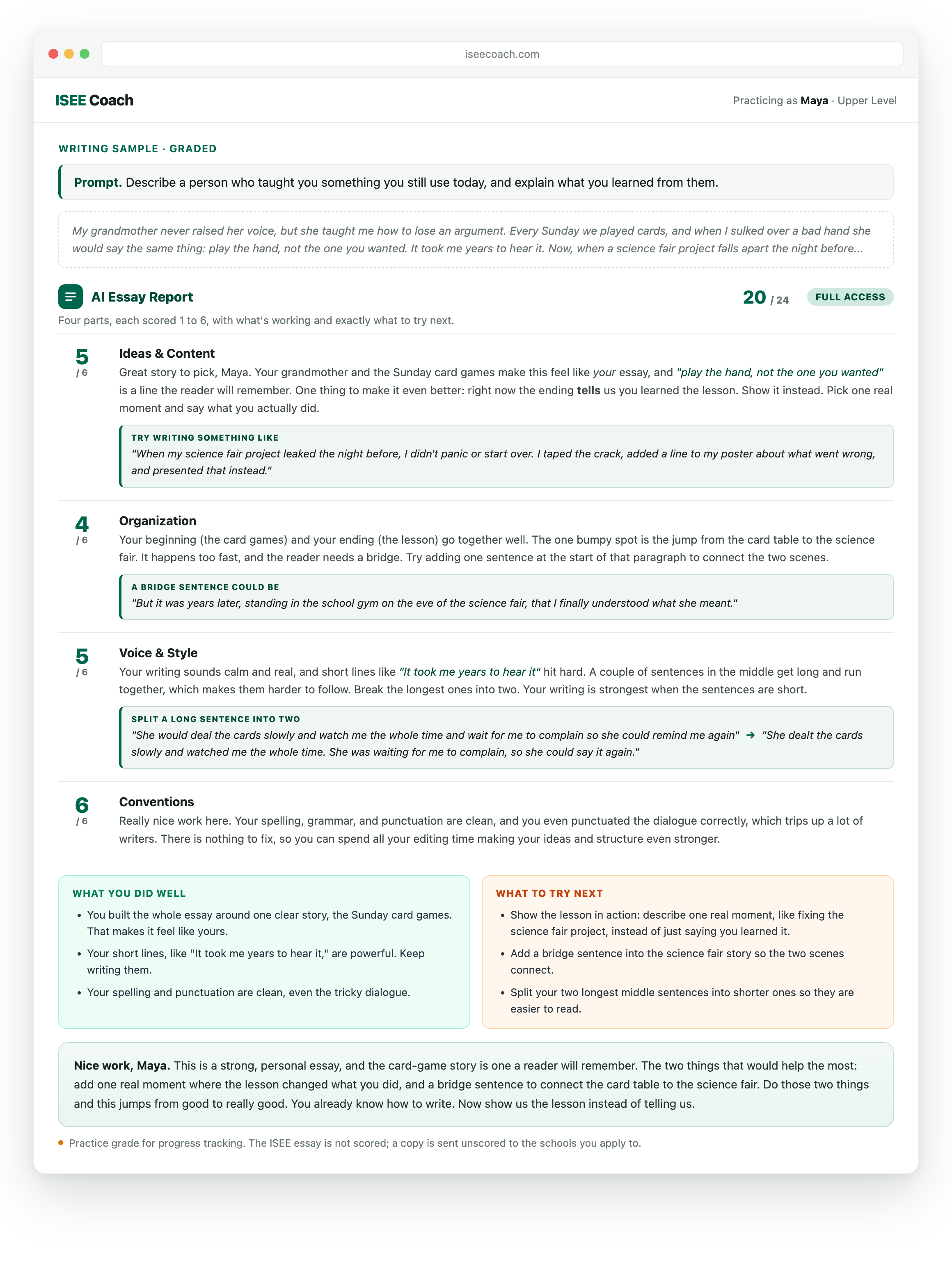
ISEE Coach has timed 30-minute essay practice with ISEE-style prompts at each level. When your child submits an essay, the AI Essay Report scores four parts, Ideas and Content, Organization, Voice and Style, and Conventions, each from 1 to 6. Each part explains what is working and gives a specific example to try, like a sentence the student could write or a long sentence split into two. The report ends with what your child did well and what to try next.

These practice grades are for tracking progress only, since the ISEE essay is not scored. The free plan includes one graded essay. Full Access ($149 for 90 days, no auto-renewal) includes up to 20 essay grades. Essays are processed by a third-party AI provider, as our privacy policy explains. To fit essay practice into a weekly schedule, see the ISEE study plan, and for what else is on your child's test, see the Middle Level guide.
No. The essay is not scored. It is sent without a grade to the schools that receive your child's scores, and each school reads it in its own way.
Yes, on the online test. Students taking the ISEE online, at a test center or at home, type the essay. Students taking the paper test write it by hand in black or blue ballpoint pen.
The ISEE gives 30 minutes and one prompt. Three to five focused paragraphs is a comfortable goal for most students. A shorter essay with a clear point and one strong example reads better than a long one that wanders.
Yes. Schools use it to see how clearly a student expresses ideas, their grammar and spelling, and their thoughts and values. They may also compare it with other writing in the application.
No. The essay goes only to the schools, and families do not receive a copy.
Start with a free 15-minute starter set, no sign-up needed. Then take a full-length, timed ISEE diagnostic at the Lower, Middle, or Upper Level and get a report on which subskills need work.
Try the free starter setNo credit card. No auto-renewal. Try a 15-minute starter set with no sign-up, then take a full diagnostic free.
More ISEE guides: ISEE scores · ISEE timing and pacing · Quantitative comparisons · ISEE vs SSAT · ISEE study plan · Sentence completions · ISEE synonyms · Free ISEE practice test · Lower Level guide · Middle Level guide · Upper Level guide