To study for the ISEE in 8 weeks, start with a full, timed practice test to find the weakest subskills, then spend about 15 to 30 minutes a day on those subskills and a little vocabulary. Take a full practice test about every three weeks, answer every question since there is no guessing penalty, and keep the final week light.
Begin with a full, timed practice test, including the essay. Its report shows which sections and subskills have the most room to grow.
Spend most of the next weeks on the two or three weakest subskills, in short sessions of about 15 to 30 minutes a day, five days a week.
Take a full practice test about every three weeks (weeks 1, 4, and 7) to see what changed and update the focus list.
The ISEE has no penalty for wrong answers, so practice answering every question in every section. Keep the last week light.
The 8-week ISEE study plan
Week
Focus
What to do (about 15 to 30 minutes a day)
1
Find the starting point
Take a full, timed practice test with all four sections and the essay. From the score report, choose the two or three weakest subskills, such as sentence completions, quantitative comparisons, or geometry.
2 and 3
Work on the weakest subskills
Five short sessions a week on the focus subskills. Add a few minutes of vocabulary each day. Write one timed 30-minute essay.
4
Check progress
Take a second full practice test. Compare it with the first, and choose the focus subskills for the next two weeks.
5 and 6
Build pace and stamina
Keep the short subskill sessions, and add one full timed section each week, such as Reading Comprehension or Mathematics Achievement. Write a second timed essay.
7
Final full test
Take a third full practice test. Go over every missed question and check that no question was left blank.
8
Rest and review
One or two short sessions and a few minutes of vocabulary, with no new topics. Plan the route, the start time, and what to bring. Sleep well the night before.
The ISEE is long: about 2 hours 20 minutes at the Lower Level and about 2 hours 40 minutes of testing at the Middle and Upper Levels, plus two short breaks. The three full tests in this plan are how a student gets used to that length. For the time limits of each section, see ISEE timing and pacing.
What one practice session looks like
Choose one subskill, such as synonyms, fractions, or main idea questions in Reading.
Answer a short timed set, about 15 questions in 15 minutes.
Go over each miss right away. Read why the correct answer works and what made the wrong choice look right.
Try one more question on the same subskill to check that the idea makes sense now.
Short sessions spread across the week fit around school and activities, and they give new ideas time to settle between sessions. On timed sets, practice the ISEE habit of answering every question. A blank and a wrong answer both score zero, so a guess can only help. Try this: when about one minute is left in a timed set, stop and choose an answer for every question still blank.
Vocabulary: a little every day
ISEE Verbal Reasoning is synonyms and sentence completions, and the pace is quick: 40 questions in 20 minutes at the Middle and Upper Levels, 34 in 20 at the Lower Level. Vocabulary also helps in Reading Comprehension. Words are learned slowly over many short looks, so vocabulary is the one area to practice nearly every day, even for five minutes.
Try this: keep a list of words your child missed in practice. Each day, review ten of them and use two in a sentence out loud. Mix in a few sentence completions each week, since they test how a word fits in context. The synonyms guide and the sentence completion guide have methods for each question type.
Adjusting the plan
Four weeks: take a full test in week 1 and week 3. Spend the time between on the two weakest subskills, pacing, and answering every question. Keep week 4 light.
Twelve weeks or more: use the same pattern with a full test about every three to four weeks. Spend the extra time on vocabulary, reading, and any math topics your child has not learned in school yet.
Busy weeks: two or three 15-minute sessions still count and keep the habit going. Pick the weakest subskill for those sessions.
A note for younger Lower Level students
The ISEE is written for a range of grades, so it includes some topics a younger student has not been taught yet, like certain fractions, ratios, or early algebra. A topic that is new needs to be taught before it can be practiced. Our free sister site Numbercade has math games that teach concepts like these, with a short lesson before each challenge. The Lower Level guide and the Middle Level guide list the topics that are most often new. Try this: after the first practice test, mark any missed question on a topic your child says they have never seen, and teach those topics first.
How ISEE Coach helps with this
The free diagnostic is a full-length, timed ISEE practice test at your child's level. Its score report shows accuracy by section and subskill, which is the starting point for week 1.
15-minute topic practice of 15 questions, one subskill at a time, matches the short sessions in this plan. Every wrong answer opens an explanation.
Three full practice tests per level with Full Access (the free diagnostic is the first), which fit weeks 1, 4, and 7.
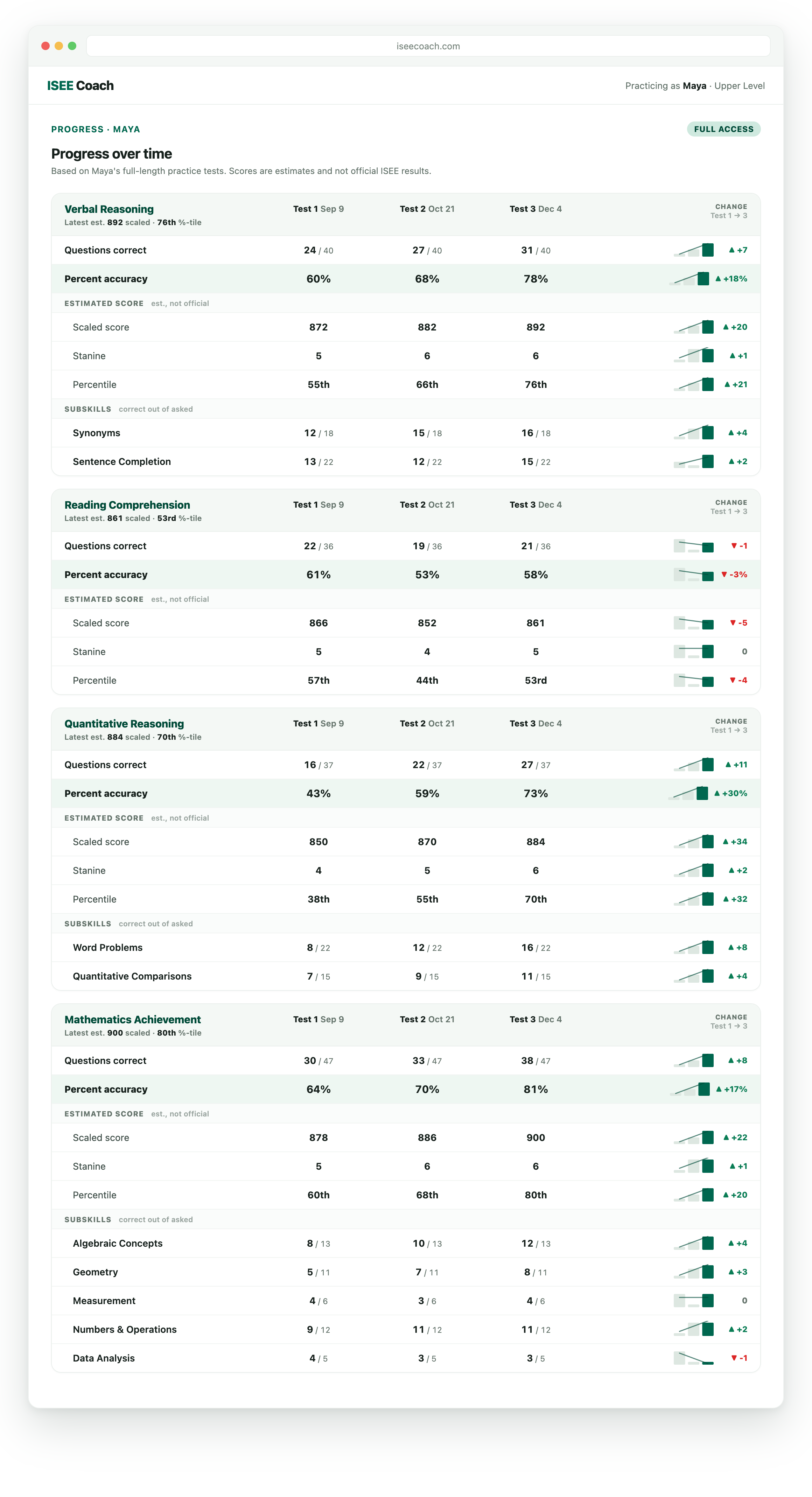
The Progress report with Full Access puts the full tests side by side, section by section, with focus recommendations for what to work on next.
Sample Progress report, shown with example data. Each section lists questions correct, accuracy, estimated scores, and subskills for Test 1, Test 2, and Test 3, with the change from the first test to the third. Scores are estimates. Tap to see it full size.
To read the scaled scores, stanines, and percentiles in the report, see ISEE scores explained.
Common questions
How many hours a week should my child study for the ISEE?
For most students, about 15 to 30 minutes a day, five days a week, is enough. That is roughly one and a half to two and a half hours a week, plus a full practice test about every three weeks.
When should we start preparing for the ISEE?
Many families start about 8 to 12 weeks before the test date. Four weeks is enough time to learn the format and pacing and to work on the two weakest subskills. Starting earlier leaves room to teach math topics that are new and to build vocabulary slowly.
Should my child take all the practice tests?
Three full, timed practice tests spread a few weeks apart work well: one to find the starting point, one to check progress, and one close to test day. Taking them closer together leaves less time to work on what each report shows.
What if my child is not ready for some of the math topics?
That is common, because each ISEE level covers more than one grade. Teach the new topic first, then practice it in ISEE format. For Lower and Middle Level math, the free games on Numbercade teach many of these concepts.
Should my child guess on the ISEE?
Yes. The ISEE has no penalty for wrong answers, so a guess can only help. Students should answer every question before time runs out in each section.
See where your child stands
Start with a free 15-minute starter set, no sign-up needed. Then take a full-length, timed ISEE diagnostic at the Lower, Middle, or Upper Level and get a report on which subskills need work.