ISEE timing: how much time per question, and how to pace
On the ISEE, Verbal Reasoning gives 30 seconds per question at the Middle and Upper Levels and about 35 seconds at the Lower Level. The other three sections give about 51 to 60 seconds per question. There is no penalty for wrong answers, so students should guess on any question they have not answered before time runs out.
Verbal Reasoning is the fastest section: 30 seconds per question at the Middle and Upper Levels, and about 35 seconds at the Lower Level.
Quantitative Reasoning, Reading Comprehension, and Mathematics Achievement give about 51 to 60 seconds per question. Reading time for the passages comes out of that same clock.
The ISEE does not take points off for wrong answers. A blank always scores zero, so every question should get an answer before time runs out.
Time per question by section and level
These numbers divide each section's time evenly across its questions, using the counts in ISEE's Quick Facts Guide. The Lower Level is for students applying to grades 5 and 6. The Middle Level (grades 7 and 8) and the Upper Level (grades 9 to 12) have the same counts and times.
Section
Lower Level
Middle and Upper Level
Verbal Reasoning
34 in 20 min: about 35 seconds
40 in 20 min: 30 seconds
Quantitative Reasoning
38 in 35 min: about 55 seconds
37 in 35 min: about 57 seconds
Reading Comprehension
25 in 25 min: 60 seconds
36 in 35 min: about 58 seconds
Mathematics Achievement
30 in 30 min: 60 seconds
47 in 40 min: about 51 seconds
Essay
1 prompt in 30 min
1 prompt in 30 min
Total testing time
2 hours 20 minutes
2 hours 40 minutes
The sections come in this order: Verbal Reasoning, Quantitative Reasoning, a break, Reading Comprehension, Mathematics Achievement, a second break, and then the essay. Both breaks are scheduled, and the Quick Facts Guide lists them as 10 minutes each. No calculator is allowed in either math section.
An even split is a starting point. Some questions take less time than the average and some take more. The goal is to reach the last question with a little time left over.
Why students run out of time
Verbal: synonyms are quick, sentence completions are not
The Verbal section starts with synonyms, where a student who knows the word can answer in a few seconds. Sentence completions come next and take longer, because the student has to read the whole sentence and find the clue that points to the answer. At the Upper Level, some sentence completions have two blanks. Students who spend 30 seconds on every synonym often reach the sentence completions already behind. See our guides to ISEE synonyms and sentence completions for how to work each type.
Try this: move through the synonyms at a steady clip and bank the extra seconds for the sentence completions.
Reading: the passages take time too
At the Middle and Upper Levels, Reading Comprehension gives about 58 seconds per question, and that includes the time spent reading each passage. A student who reads every passage slowly, or rereads it for each question, can run short on the last passage.
Try this: read each passage once for the main idea, then go back to the lines each question points to.
Math: getting stuck on one setup
In Quantitative Reasoning (about 57 seconds per question) and Mathematics Achievement (about 51 seconds per question at the Middle and Upper Levels), most time goes to questions where the student is not sure how to start. Three minutes on one hard word problem costs the time for three easier questions later in the section. At the Middle and Upper Levels, quantitative comparisons can often be answered quickly with the right approach.
Try this: if you have not found a way to start a math question after about a minute, pick your best answer, mark it, and move on.
A pacing plan for test day
Check the clock at the halfway point
Halfway through each section's time, a student on pace has answered about half the questions. These checkpoints are computed from the section counts above.
Section
Lower Level: halfway checkpoint
Middle and Upper Level: halfway checkpoint
Verbal Reasoning
Question 17 with 10:00 left
Question 20 with 10:00 left
Quantitative Reasoning
Question 19 with 17:30 left
Question 19 with 17:30 left
Reading Comprehension
Question 13 with 12:30 left
Question 18 with 17:30 left
Mathematics Achievement
Question 15 with 15:00 left
Question 24 with 20:00 left
If your child is well behind the checkpoint, that is the signal to speed up and skip the hardest questions for now. If they are well ahead, they can slow down a little and read more carefully.
Move on, then come back
ISEE's own test tips say not to spend too much time on any one question, and that students may return to skipped questions within the current section if time permits. A simple habit works well: answer what you can, pick a best guess on anything that is taking too long, mark it, and come back to it at the end of the section.
The last minute: fill every blank
Because the ISEE has no penalty for wrong answers, a guess can only help. Scores are based on the number of correct answers, so a blank is the same as a wrong answer.
Try this: when one minute is left in a section, stop working on the current question and choose an answer for every question that is still blank. To fit timed practice into each week, see our ISEE study plan.
How ISEE Coach helps with this
Every ISEE Coach practice test uses the ISEE's section lengths and time limits, so your child practices at test-day pace. After full-length practice tests, the Pacing report shows how your child is spending the clock.
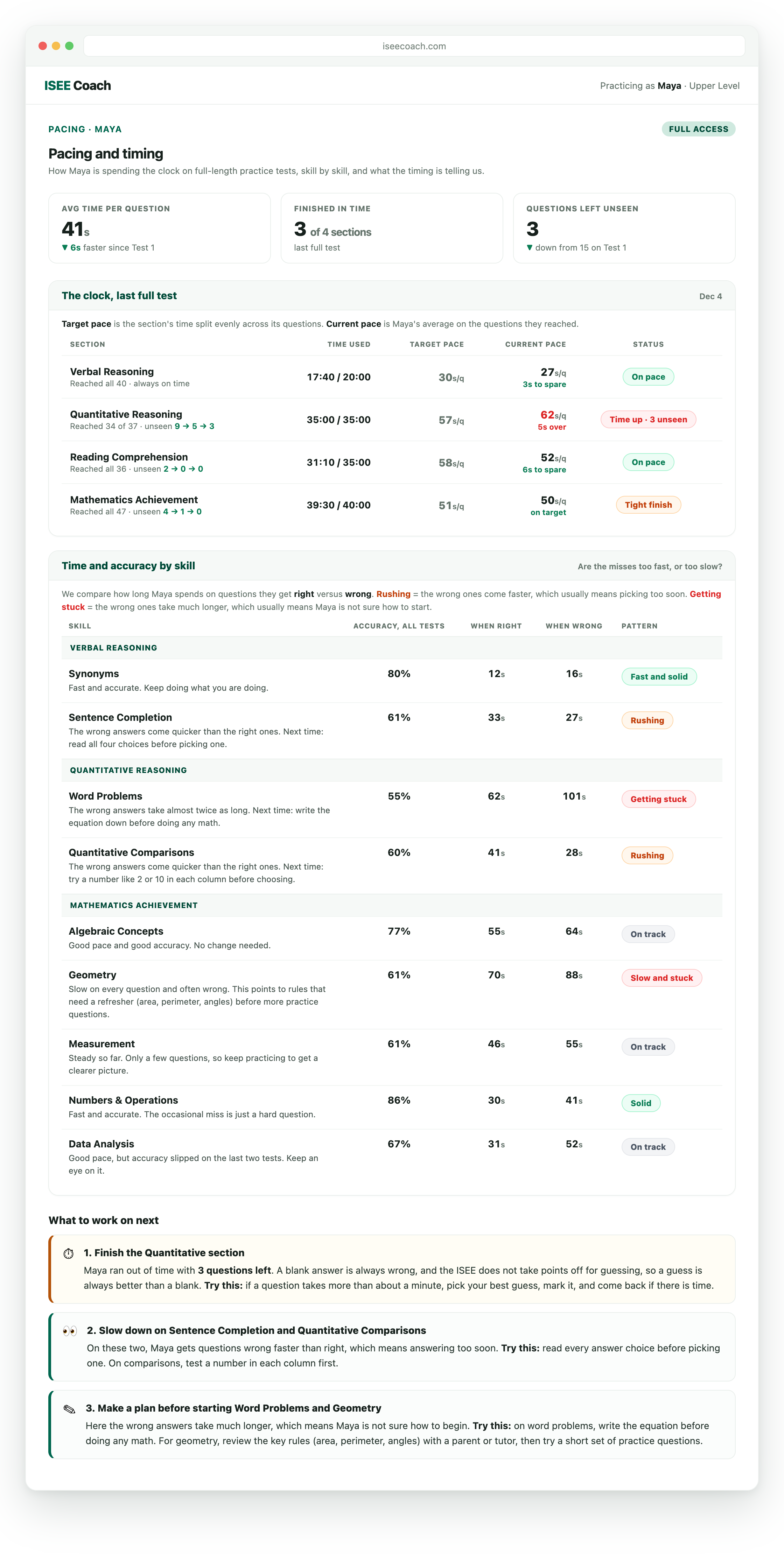
The Pacing report: time used and pace for each section, time on right and wrong answers by skill, and what to work on next.
For each section, the report compares your child's current pace with the target pace and counts any questions they did not reach. For each skill, it compares the time spent on questions answered right with the time spent on ones answered wrong. Wrong answers that come much faster are marked as rushing. Wrong answers that take much longer are marked as getting stuck. The report ends with a short list of next steps, each with a Try this suggestion. The free plan includes one full-length timed diagnostic. Full Access includes three full-length practice tests per level.
Common questions
How much time per question is there on the ISEE?
At the Middle and Upper Levels, Verbal Reasoning gives 30 seconds per question. Quantitative Reasoning, Reading Comprehension, and Mathematics Achievement give about 51 to 60 seconds per question across all levels. At the Lower Level, Verbal Reasoning gives about 35 seconds per question. Reading time for passages counts against the Reading Comprehension clock.
Should you guess on the ISEE?
Yes. The ISEE does not take points off for wrong answers, and scores are based only on correct answers. Before time runs out in each section, choose an answer for every question that is still blank.
Are there breaks during the ISEE?
Yes. The Lower, Middle, and Upper Levels have two scheduled breaks: one after Quantitative Reasoning and one after Mathematics Achievement, before the essay. ISEE's Quick Facts Guide lists them as 10 minutes each.
Can you go back to an earlier section of the ISEE?
ISEE's test tips say students may return to skipped questions within the current test section if time permits. For the online test, ISEE's at-home family guide adds that students cannot leave a section until its time is up, and can use any extra time to review their answers in that section. Plan to finish each section before its time runs out.
Is the at-home ISEE timed the same as the test at a school or test center?
Yes. At-home testing uses the online format, and ISEE's Quick Facts Guide says the online and paper formats have the same number of questions and the same timing, and that the test itself is the same across all testing locations.
See where your child stands
Start with a free 15-minute starter set, no sign-up needed. Then take a full-length, timed ISEE diagnostic at the Lower, Middle, or Upper Level and get a report on which subskills need work.