ISEE scores explained: scaled scores, percentiles, and stanines
Each scored ISEE section gets a scaled score from 760 to 940, a percentile from 1 to 99, and a stanine from 1 to 9. The percentile and stanine compare your child only with other students applying to the same grade, and a stanine of 5 is the middle. There is no single good score; each school decides how to use the results.
Each of the four scored sections gets three numbers: a scaled score from 760 to 940, a percentile from 1 to 99, and a stanine from 1 to 9.
The percentile and stanine compare your child only with other students applying to the same grade who took the ISEE in the past three years.
The essay is not scored. An unscored copy goes to each school that receives the score report.
There is no penalty for wrong answers, so the scores come from the number of questions answered correctly.
Scaled score, percentile, and stanine
Scaled score (760 to 940)
The scaled score starts from the raw score, which is the number of questions your child answered correctly. The test has several versions, and the scaled score adjusts for small differences between them, so a given scaled score means the same thing whichever version your child took. Every section at every level (Lower, Middle, and Upper) uses the same 760 to 940 range.
Percentile (1 to 99)
A percentile is not the percent of questions answered correctly. A percentile of 65 means your child scored as well as or better than 65 percent of the students in the comparison group, called the norm group. That group is all students applying to the same grade who took the ISEE over the past three years.
Stanine (1 to 9)
A stanine groups the percentiles into nine bands, with 5 in the middle. The bands are not the same size: the middle bands cover more students than the ones at the ends. Stanines 4, 5, and 6 together cover the 23rd to 76th percentiles. Schools often look at stanines because a small change in percentile may not mean a meaningful change in skill.
Each ISEE level covers more than one grade. The Lower Level is for students applying to grades 5 and 6, the Middle Level for grades 7 and 8, and the Upper Level for grades 9 to 12. Everyone at a level takes the same test, but percentiles and stanines are figured separately for each grade.
So a 4th grader applying to grade 5 and a 5th grader applying to grade 6 can answer the same number of questions correctly and get different stanines. The younger student is compared only with other younger students. This is also why it is normal for the youngest students at a level to see questions they have not been taught yet. The Lower Level guide and the Middle Level guide list the topics that most often come up early.
The publisher also notes that the norm group is a competitive one: students applying to selective schools. A percentile on the ISEE can look lower than a percentile on a school test that compares your child with a wider group.
What is on the Individual Student Report
The Individual Student Report (ISR) is the score report families and schools receive. It includes:
Test Profile: the scaled score, percentile, and stanine for each of the four sections.
Stanine Analysis: a side-by-side look at Verbal Reasoning with Reading Comprehension, and Quantitative Reasoning with Mathematics Achievement. Each stanine is shown as a band one stanine above and below, so a 5 shows as 4 to 6.
Analysis: a breakdown of the questions in each section, with a key that explains the symbols in the results.
The essay is not on the report. Families do not receive a copy of it, but each school on your score list gets an unscored copy. You can read more in the publisher's score reports page. Because the essay still reaches schools, it is worth practicing; see the ISEE essay guide.
What counts as a good ISEE score
There is no single passing score. Each school decides how to use ISEE results, and schools look at the whole application along with the test. A stanine of 5 is right in the middle of your child's grade group. Stanines of 7 and above are in the top quarter or so, and many selective schools see a lot of applicants in that range. The best way to know what a school expects is to ask its admission office.
Two things help any score. First, answer every question: a blank and a wrong answer both count as zero. Second, get the timing right, so your child reaches the end of every section. The timing and pacing guide shows the seconds per question for each section. Try this: after a timed practice section, count how many questions your child left unanswered or guessed on in the last two minutes, and set a goal to cut that number on the next one.
How ISEE Coach helps with this
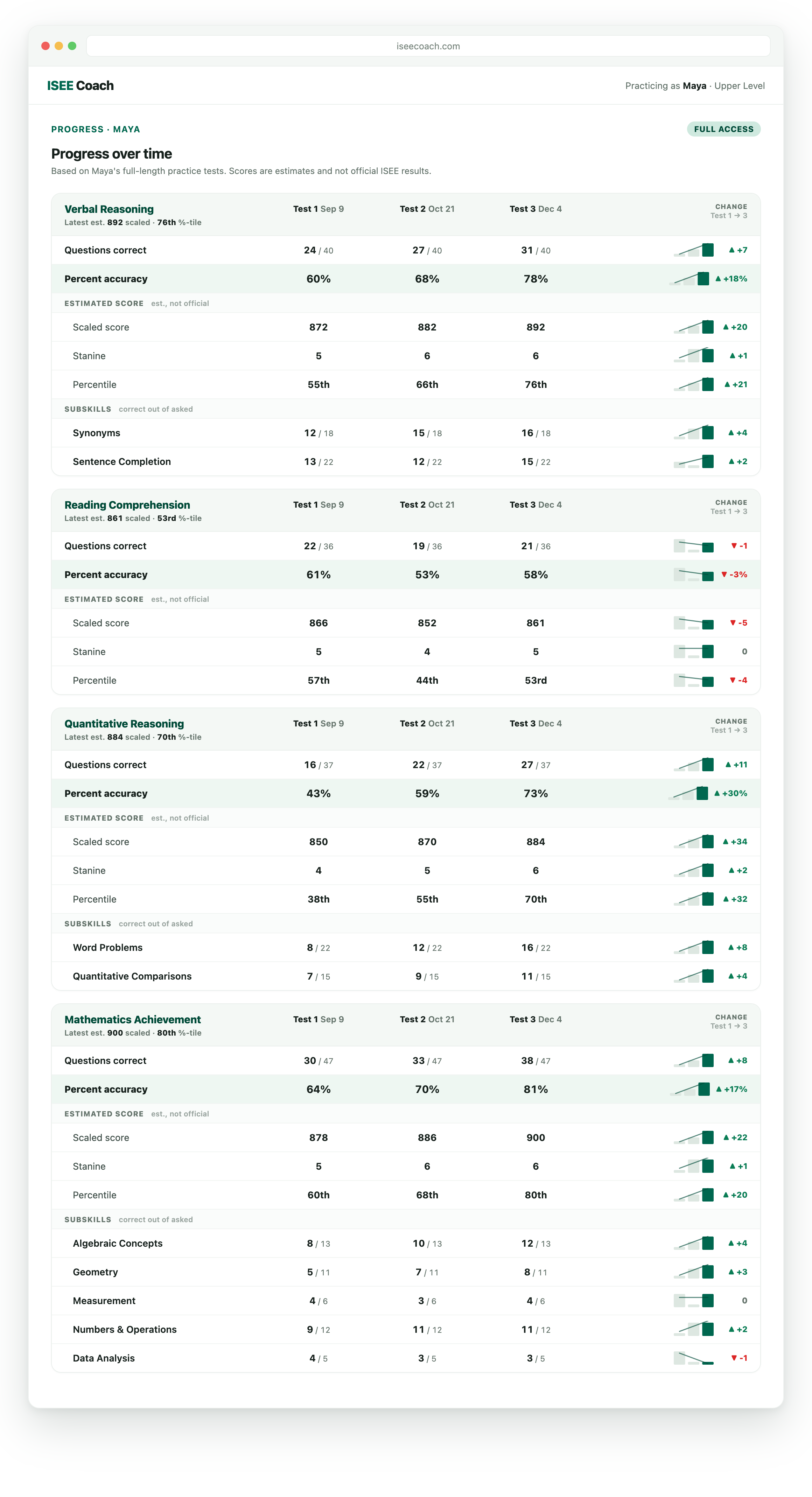
Every full-length practice test on ISEE Coach ends with a score report by section and subskill. With Full Access, the Progress report puts your child's recent full tests side by side. For each section it shows questions correct, percent accuracy, an estimated scaled score, stanine, and percentile, and the correct count for each subskill, with the change since the first test.
The Progress report: each section across three practice tests, with estimated scores and subskills.
Our scaled scores, stanines, and percentiles are estimates. We base them on how many questions your child answers correctly, and only the ISEE itself can give your child's actual scores. For the Lower Level, the estimates are grade-aware: a student applying to grade 6 needs more correct answers than a student applying to grade 5 for the same estimated stanine, just as on the ISEE. Use the estimates to spot trends, like a section that is climbing or one that has stalled, and the subskill rows to decide what to practice next.
There is no passing score, and each school uses ISEE results in its own way. A stanine of 5 is in the middle of your child's grade group, and stanines of 7 to 9 are at about the 77th percentile and above. Ask each school's admission office what it looks for.
What is a stanine on the ISEE?
A stanine is a score from 1 to 9 that groups percentiles into nine bands, with 5 in the middle. For example, stanine 5 covers the 40th to 59th percentiles and stanine 9 covers the 96th to 99th. It compares your child only with students applying to the same grade.
Do schools see the ISEE essay?
Yes. The essay is not scored, but an unscored copy is sent to each school that receives your child's score report. Families do not receive a copy of the essay.
Can you retake the ISEE?
Yes. A student may take the ISEE once per testing season. There are three seasons: fall (August to November), winter (December to March), and spring and summer (April to July).
What is the ISEE Individual Student Report?
The Individual Student Report is the score report sent to families and schools. It shows a scaled score, percentile, and stanine for each section, a Stanine Analysis that compares related sections, and a breakdown of the questions in each section.
See where your child stands
Start with a free 15-minute starter set, no sign-up needed. Then take a full-length, timed ISEE diagnostic at the Lower, Middle, or Upper Level and get a report on which subskills need work.