An ISEE synonym question asks you to pick the choice closest in meaning to the word in capital letters. The best method is to define the word in your own words before you look at the choices, then find the match. When you are unsure, use the word's parts, whether it feels positive or negative, and a sentence you have heard it in.
Each synonym question shows one word in capital letters and four answer choices, A to D. Your job is to pick the choice closest in meaning to the capitalized word. Synonyms come first in the Verbal Reasoning section, before the sentence completions. At the Lower Level, Verbal Reasoning has 34 questions in 20 minutes, and 17 of them are synonyms. At the Middle and Upper Levels, Verbal Reasoning has 40 questions in 20 minutes. That is about 30 to 35 seconds per question, so a steady method matters more than long thinking.
The core method. Before you look at the choices, say what the word means in your own words. Then find the choice that matches your definition.
When you are not sure of the word, use three clues: its word parts (a prefix, root, or suffix you know), its charge (does it feel positive or negative?), and a sentence or phrase you have heard it in.
Never leave one blank. The ISEE has no penalty for wrong answers, so a smart guess can only help.
Try this: on your next ten synonym questions, cover the choices with your hand and say a definition out loud before you uncover them.
Word parts that unlock hard words
Many ISEE words are built from Latin and Greek parts. Knowing a few dozen of them lets a student make a good guess at a word they have never seen.
Word part
Type
Meaning
Example
bene-
Prefix
good, well
benefit
mal-
Prefix
bad, badly
malfunction
pre-
Prefix
before
preview
re-
Prefix
again, back
rebuild
sub-
Prefix
under
submarine
trans-
Prefix
across
transport
in-, im-
Prefix
not
invisible, impossible
chron
Root
time
chronological
dict
Root
say, speak
predict
spect
Root
look, see
inspect
aud
Root
hear
audience
port
Root
carry
portable
-phobia
Suffix
fear of
claustrophobia
-ology
Suffix
study of
biology
-ous
Suffix
full of
courageous
-able, -ible
Suffix
can be done
readable, flexible
Word parts give a clue, not a guarantee. The "in" in inflammable does not mean "not," for example. Use the part to narrow the choices, then check that your answer makes sense.
How the vocabulary changes by level
Lower Level (applying to grades 5 and 6). The words step up from everyday words a child knows, like sad or careful, to academic words like distraught or vigilance. Many are "Tier 2" words: words used often in books and school but rarely in casual talk. See the Lower Level guide for more.
Middle Level (applying to grades 7 and 8). The words come from middle and high school word lists, such as diligent or prolific. Word parts start to matter more here. The Middle Level guide covers the gap in detail.
Upper Level (applying to grades 9 to 12). The words come from high school and college-prep reading, such as laconic or parsimonious. Many have more than one meaning, and the test may use the less common one. The Upper Level guide lists more examples.
A simple daily vocabulary habit
Vocabulary grows through small, steady practice. Five to ten minutes a day works better than a long session once a week.
Keep a list of missed words. Every time your child misses a synonym or meets a new word in reading, add it to a notebook or a phone note with a short definition in their own words.
Review ten a day. Cover the definition, say it out loud, then check. Words your child gets right three days in a row can move to a "known" list.
Use one word in a sentence. Pick one word from the day's ten and use it at dinner or in a text. A word that gets used is easier to remember.
Try this: tonight, write down five words your child missed in practice and review them together for five minutes before bed.
Common traps
A related word that is not a synonym
Test writers often include a choice that goes with the word but does not mean the same thing. For a word like harvest, a choice like farm is related, while gather is the synonym. Ask: could I swap this choice in for the word in a sentence?
A secondary meaning
Some words have a common meaning and a less common one. If no choice matches the meaning you know, think of another way the word is used. Grave can mean serious as well as a burial place.
The opposite
When you are rushing, the opposite of a word can feel right, because your brain has matched the topic. Check the charge: if the word is negative, a positive choice is almost never the answer.
A look-alike or sound-alike
A choice that shares letters or sounds with the word is often a trap. Similar spelling does not mean similar meaning.
Try this: after each practice set, look at every synonym you missed and write which trap caught you: related word, secondary meaning, opposite, or look-alike.
Practice: six synonym questions
Choose the word closest in meaning to the word in capital letters. Say a definition before you look at the choices. These are original questions written for this page.
Lower Level
1. GLEE
(A) anger
(B) noise
(C) joy
(D) sleep
Show answer
(C) joy. Define it first: glee is a feeling of great happiness, like the glee of a child opening a present. That is a positive word, so anger is out. Noise can go with glee, since happy people are sometimes loud, but it does not mean the same thing.
2. HASTY
(A) careful
(B) rushed
(C) angry
(D) late
Show answer
(B) rushed. Think of a sentence you know: he made a hasty choice and wished he had waited. Hasty means done too quickly, so rushed matches. Careful is the opposite. Late is about time too, but it means something different; a hasty person is often early.
Middle Level
3. ANTIQUATED
(A) valuable
(B) outdated
(C) modern
(D) decorated
Show answer
(B) outdated. Use the word part: antiqu, as in antique, means old. Antiquated means old-fashioned and no longer useful, like an antiquated computer. Valuable is a trap: some antiques are valuable, but that is a related idea, not the meaning. Modern is the opposite.
4. ADVERSARY
(A) supporter
(B) advisor
(C) visitor
(D) opponent
Show answer
(D) opponent. Define it in your own words: an adversary is someone you compete or fight against. The word has a negative charge, which rules out supporter, the opposite. Advisor only looks similar because both start with ad.
Upper Level
5. MALADY
(A) melody
(B) remedy
(C) ailment
(D) mistake
Show answer
(C) ailment. The prefix mal- means bad, so expect a negative word. A malady is an illness or a lasting problem. Remedy is the trap: a remedy cures a malady, so the two are related but not the same. Melody only sounds alike, and a mistake is bad but is not a sickness.
6. ABRIDGE
(A) shorten
(B) connect
(C) expand
(D) publish
Show answer
(A) shorten. Recall where you have seen it: an abridged edition of a novel is a shorter version with parts cut. Connect is a trap, since the word looks like "a bridge." Expand is the opposite, and publish is related to books but means something else.
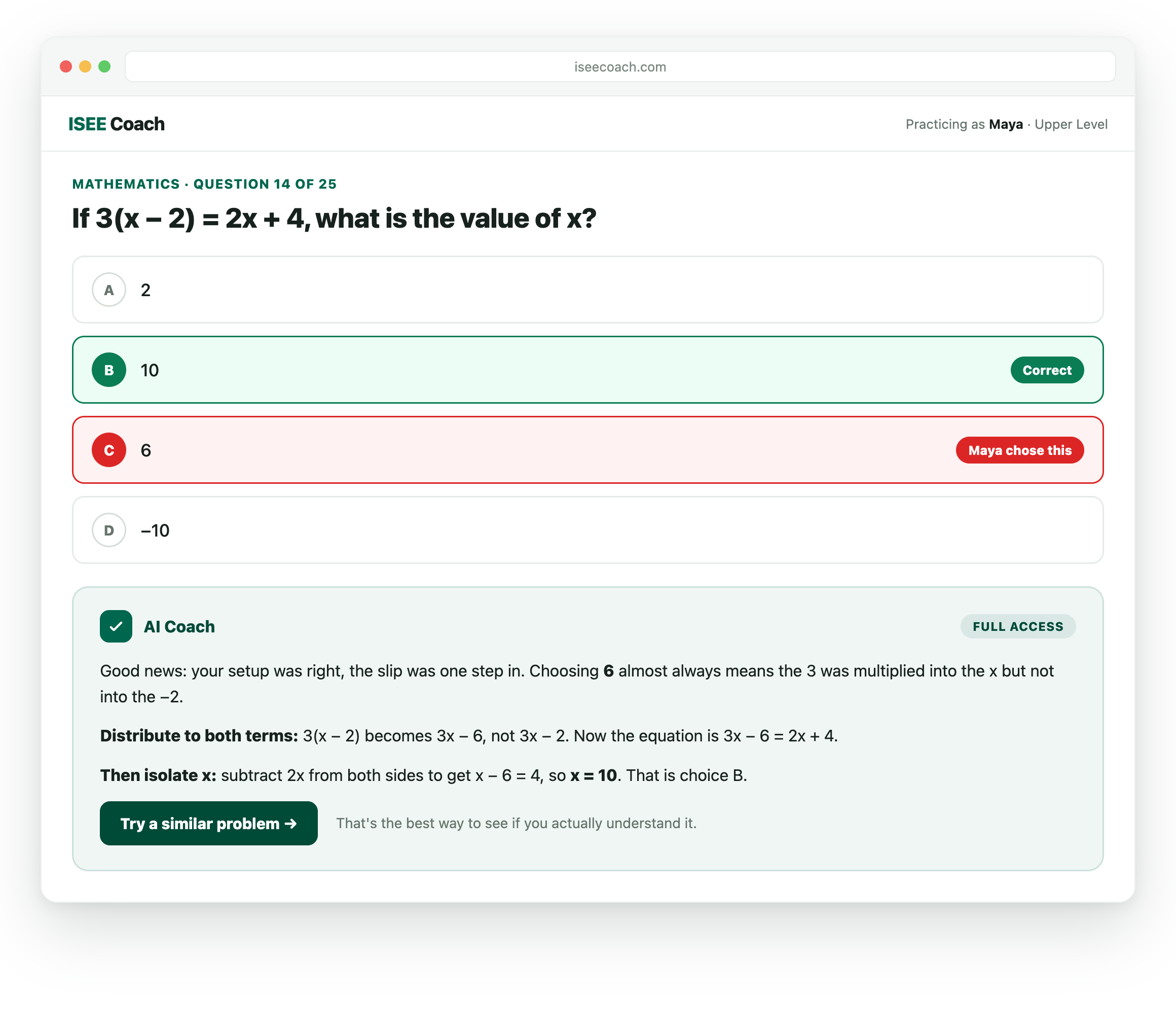
The free diagnostic's score report shows accuracy by section and by subskill, so you can see whether synonyms or sentence completions are pulling the Verbal Reasoning score down. When your child misses a question, ISEE Coach walks through it: it names the likely slip behind the answer they chose, explains the right one step by step, and offers a similar problem to try next. The free plan includes five ISEE Coach explanations. Full Access adds unlimited walkthroughs and the similar-problem generator after each miss.
ISEE Coach explains why a chosen answer was wrong, walks through the right one, and offers a similar problem. This example is an Upper Level math question.
Common questions
How many synonym questions are on the ISEE?
At the Lower Level, 17 of the 34 Verbal Reasoning questions are synonyms, and the rest are sentence completions. At the Middle and Upper Levels, Verbal Reasoning has 40 questions in 20 minutes, split between synonyms and sentence completions.
What words should my child study for ISEE synonyms?
Start with the words your child misses in practice, because those are the gaps that matter for them. Add common Latin and Greek word parts, like bene-, mal-, chron, and spect, which help with many words at once. Tier 2 academic words, the kind found in school books and articles, are the best general list.
Does reading help with ISEE synonyms?
Yes. Reading a mix of books, news articles, and nonfiction exposes a student to the academic words the ISEE uses. Reading works best when your child notes new words and looks them up. Try this: keep a sticky note in the book and write down any word they cannot define.
Should my child guess on synonym questions they do not know?
Yes. The ISEE has no penalty for wrong answers, so every question should get an answer. Rule out choices that do not fit the word's charge or word parts, then pick from what is left.
See where your child stands
Start with a free 15-minute starter set, no sign-up needed. Then take a full-length, timed ISEE diagnostic at the Lower, Middle, or Upper Level and get a report on which subskills need work.