ISEE sentence completions give you a sentence with a blank and four choices, and you pick the word or phrase that fits best. Cover the choices, find the clue and the signal word in the sentence, predict your own word, then choose the answer closest to it. On Upper Level two-blank questions, fill in the easier blank first and cross off every pair that does not fit.
A sentence completion gives you a sentence with a blank and four answer choices, A to D. You pick the word or phrase that best completes the sentence.
The method has four steps: cover the choices, find the clue and the signal word, predict your own word, then match your prediction to a choice.
At the Upper Level, some questions have two blanks. Fill in the easier blank first and cross off every pair that does not fit it.
There is no penalty for wrong answers on the ISEE, so answer every question.
What sentence completions look like at each level
Verbal Reasoning is the first section of the ISEE. It starts with synonyms (see our guide to ISEE synonyms) and then moves to sentence completions. The whole section is 20 minutes. According to ERB's What to Expect on the ISEE guides, the sentence completions look a little different at each level:
Lower Level (34 Verbal questions): about 17 sentence completions. Most ask for a single word. About 6 ask for a phrase that finishes the sentence. (ERB Lower Level guide)
Middle Level (40 Verbal questions): 17 to 23 sentence completions, each with one missing word. (ERB Middle Level guide)
Upper Level (40 Verbal questions): about 21 sentence completions. About 12 have one blank and about 9 have two blanks, where each choice is a pair of words. (ERB Upper Level guide)
A few Verbal questions on each test are unscored trial items, and you cannot tell which ones they are, so treat every question as if it counts.
The four-step method
Cover the choices. Read the sentence first, without looking at the answers. The choices are written to sound good, so it helps to have your own idea before you see them.
Find the clue. Every sentence has a word or phrase that tells you what the blank must mean. In "The trail was so _____ that we stopped to rest every few minutes," the clue is "stopped to rest every few minutes."
Find the signal word. Words like "but," "because," and "so" tell you whether the blank agrees with the clue or goes against it. In the trail sentence, "so ... that" means the blank causes the resting.
Predict, then match. Say your own word for the blank, such as "steep" or "tiring." Then pick the choice closest in meaning to your word. Read the full sentence once more with that choice in place.
ERB's own guides give the same advice: fill in the blank in your head first, then look for the choice closest to your answer. Try this: on your next ten practice questions, write your predicted word in the margin before you look at the choices, then check how often your word matched the answer.
Signal words and what they do to the blank
Signal words are the fastest way to know which direction the blank should go. Learn these groups and look for them every time.
Type
Common signal words
What it means for the blank
Example
Contrast
although, but, however, despite, even though, yet, while, instead, unlike
The blank goes against the clue.
Although the puppy was small, it was very _____. (brave, loud, strong)
Continuation
and, also, in addition, not only ... but also, in fact, a colon or semicolon
The blank agrees with the clue or adds more of the same idea.
The speech was clear and _____. (simple, well organized)
Cause and effect
because, since, so, therefore, as a result, so ... that
The blank is the cause or the result of the clue.
Because the soup was too hot, Leo let it _____. (cool)
Negative
not, never, far from, hardly, rarely, lacking
Flips the meaning. Work out the sentence without the negative, then take the opposite.
The room was far from _____; toys covered the floor. (tidy)
Some sentences have no signal word at all. In that case, the blank usually restates the clue, often after a comma or a colon. Try this: circle the signal word in every practice sentence, and if you cannot find one, underline the words the blank is describing.
Two-blank questions (Upper Level)
On a two-blank question, each choice is a pair of words, and the correct pair must fit both blanks. That gives you a shortcut: you only need one bad word to rule out a whole pair.
Pick the easier blank. Usually one blank has a stronger clue next to it. It does not have to be the first one.
Predict a word for that blank only, and cross off every pair whose word for that blank does not fit.
Test the remaining pairs in the other blank. Often only one or two are left.
Read the whole sentence with both words in place. Check that the two words relate to each other the way the signal word says. With "although," they should pull in opposite directions. With "and," they should agree.
Two-blank questions take a little longer, so keep an eye on the clock. Our ISEE timing and pacing guide covers how to budget about 30 seconds per Verbal question. For more on the Upper Level test as a whole, see the Upper Level prep guide.
Common traps
The choice that sounds right. A word can sound natural in the sentence and still not match the clue. "The hike was so _____ that we rested often" sounds fine with "beautiful," but beauty does not explain the resting.
The word that matches the topic. In a sentence about rain, choices like "stormy" and "damp" feel related. If the signal word is a contrast, those topic words are exactly the wrong direction.
Missing a negative. Words like "not," "hardly," and "far from" reverse the meaning. Students who read quickly skip them and choose the opposite of the answer.
Checking only one blank. On two-blank questions, a pair with a perfect first word can still have a wrong second word.
Choosing a hard word because it is hard. The answer is the choice that fits the clue, whether it is a simple word or an unusual one.
Try this: when you review a missed question, name which trap caught you. After a week, you will usually see one trap that comes up more than the others, and that is the one to watch for first.
Practice set: six original questions
These questions were written for this guide and match the ISEE format. For each one, find the clue and the signal word before you look at the choices.
Lower Level
1. Marcus usually talks nonstop at lunch, but on the day of the spelling bee he was so nervous that he stayed _____ the whole time.
(A) cheerful
(B) silent
(C) hungry
(D) busy
Show answer
(B) silent. The clue is "talks nonstop," and the signal word "but" tells you the blank means the opposite. The opposite of talking nonstop is saying nothing. Cheerful, hungry, and busy have nothing to do with talking.
2. Because the town library was closing early for the holiday, Priya _____.
(A) stayed late to finish reading at her favorite table
(B) went to the library later than she usually did
(C) told her friends the library would be open all night
(D) returned her books in the morning instead of the afternoon
Show answer
(D) returned her books in the morning instead of the afternoon. The signal word "because" means the blank is a result of the clue, "closing early." A sensible result is going earlier than usual. The other three choices all go against the clue.
Middle Level
3. Ms. Ortiz is a _____ gardener: not only does she grow vegetables in every season, but she also teaches free planting classes to her neighbors.
(A) devoted
(B) reluctant
(C) careless
(D) temporary
Show answer
(A) devoted. The signal words "not only ... but also" add more of the same idea, so the blank must agree with the clues: gardening in every season and teaching for free. Someone who gives that much time is devoted. Reluctant and careless point the wrong way, and temporary does not fit gardening all year.
4. Despite the forecast of heavy rain, the afternoon turned out to be _____, and the class picnic went on as planned.
(A) stormy
(B) damp
(C) pleasant
(D) gloomy
Show answer
(C) pleasant. The signal word "despite" sets up a contrast with the clue, "heavy rain," and the picnic going on as planned confirms good weather. Stormy, damp, and gloomy all match the rainy forecast, which is the trap.
Upper Level
5. The critic's review of the play was far from _____; she praised the actors, the music, and even the stiff wooden seats in the old theater.
(A) admiring
(B) scathing
(C) enthusiastic
(D) flattering
Show answer
(B) scathing. The clue is that she praised everything, and "far from" is a negative: the review was the opposite of the blank. The opposite of praise is harsh criticism, which is what scathing means. The other three are words for praise, so "far from" any of them would contradict the clue.
6. Although the young architect's first designs were considered _____ by her more traditional colleagues, the city later _____ them as models of creative, practical housing.
(A) mundane ... ignored
(B) sensible ... denounced
(C) outdated ... discarded
(D) unconventional ... lauded
Show answer
(D) unconventional ... lauded. Start with the second blank. The city treated the designs "as models of creative, practical housing," so the word must be positive. Only lauded (praised) works, which leaves D. Then check the first blank: "although" signals a contrast, and traditional colleagues would find creative designs unconventional. Both halves fit.
How ISEE Coach helps with this
The ISEE Coach score report shows accuracy by section and by subskill. Sentence completions have their own subskills, reported separately from Synonyms: Single Word Response, Phrase Response (Lower Level), and Two-Blank Sentence Completion (Upper Level). That shows whether your child needs work on vocabulary, on reading the clues, or on handling two blanks. You can also practice sentence completions on their own with a timer.
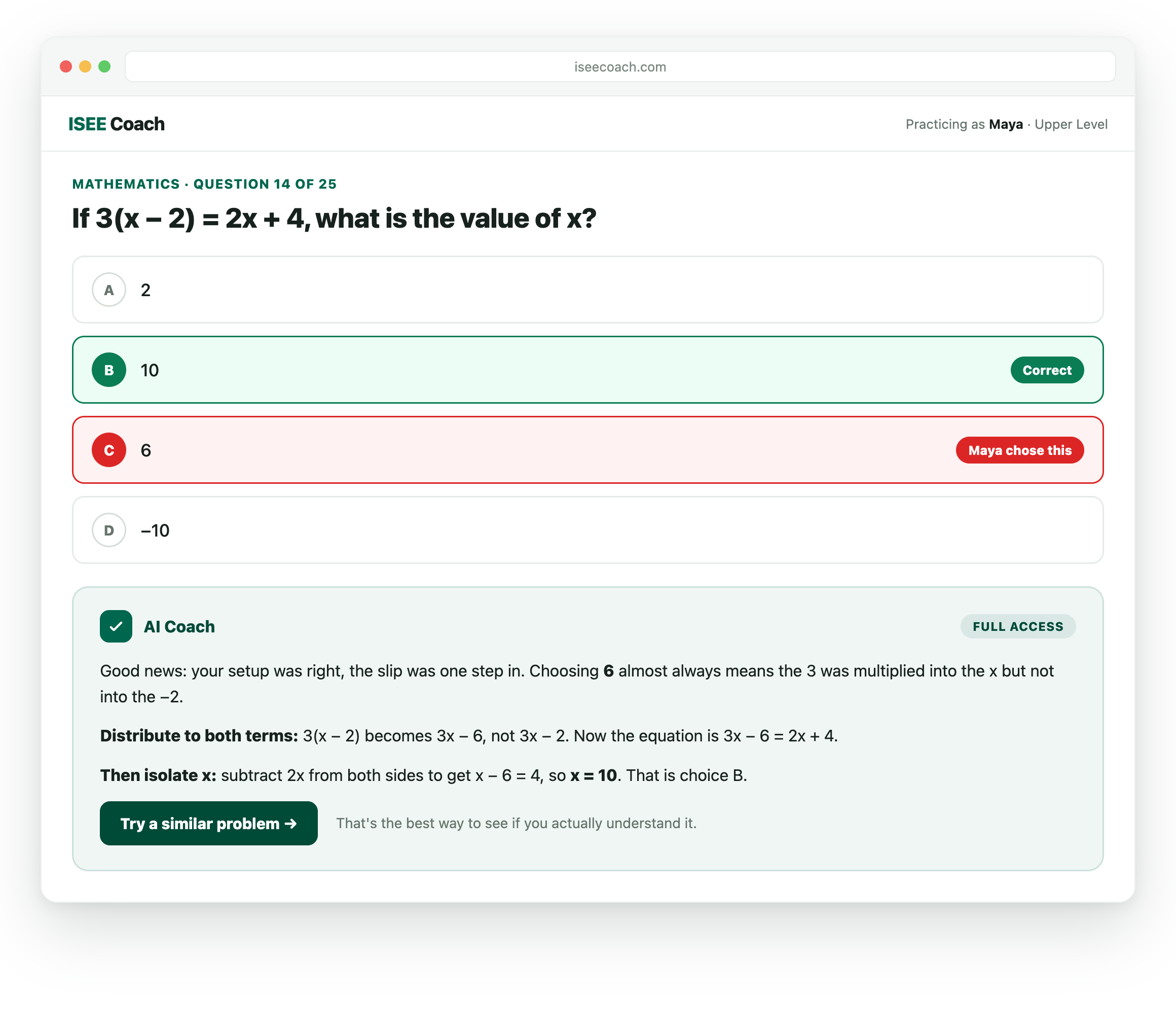
After a missed question, ISEE Coach walks through what went wrong, and for verbal questions it explains the key word and why the tempting wrong choice was a trap. With Full Access, a similar-problem generator gives your child a new question on the same skill right away. The free plan includes five ISEE Coach explanations; Full Access includes unlimited walkthroughs.
ISEE Coach after a missed question, shown here on an Upper Level math question: it names the likely slip, explains each step, and offers a similar problem to try.
How many sentence completion questions are on the ISEE?
ERB's What to Expect on the ISEE guides list about 17 at the Lower Level, 17 to 23 at the Middle Level, and about 21 at the Upper Level. They share the 20-minute Verbal Reasoning section with synonyms. A few Verbal questions on each test are unscored trial items.
Which ISEE levels have two-blank sentence completions?
Only the Upper Level. Upper Level sentence completions include both one-blank and two-blank questions. Middle Level questions have one missing word, and Lower Level questions have one missing word or phrase.
How can my child build vocabulary for sentence completions?
Read a little every day from books and articles slightly above grade level, and keep a list of new words with a short sentence for each. Learning common word roots also helps with unfamiliar words. Try this: add three new words a day to a notebook, and review the whole list once a week.
Should my child guess on sentence completions?
Yes. The ISEE has no penalty for wrong answers, so a blank and a wrong answer both score zero. If time is running out, cross off any choices that clearly do not fit and pick one of the rest.
See where your child stands
Start with a free 15-minute starter set, no sign-up needed. Then take a full-length, timed ISEE diagnostic at the Lower, Middle, or Upper Level and get a report on which subskills need work.