Quantitative comparison questions appear in the second part of ISEE Quantitative Reasoning at the Middle and Upper Levels. Each one shows two quantities, Column A and Column B, and asks whether A is greater, B is greater, the two are equal, or the relationship cannot be determined from the information given.
Take a free full-length diagnosticLast updated September 27, 2026.
Quantitative comparison questions appear at the Middle and Upper Levels, in the second part of the Quantitative Reasoning section. The Lower Level does not have them.
Each question shows two quantities, one in Column A and one in Column B. Your child decides which is greater, whether they are equal, or whether there is not enough information to tell.
The four answer choices are the same on every question, so a student who knows them well can spend all of their time on the math.
| Quantitative comparisons on the ISEE | |
|---|---|
| Levels | Middle and Upper only (not Lower) |
| Where | Part Two of Quantitative Reasoning, after the word problems |
| Section size | 37 questions in 35 minutes for all of Quantitative Reasoning |
| How many are comparisons | 14 to 17 of the 37, per ERB's What to Expect guides |
| Answer choices | The same four (A to D) on every question |
| Calculator | Not allowed |
| Wrong answers | No penalty, so answer every question |
| On the score report | Quantitative Reasoning results are listed as Word Problems and Quantitative Comparisons |
Sources: ERB's What to Expect on the ISEE guides for the Middle Level and the Upper Level. Some questions show only the two quantities. Others give a sentence of information first, such as "x is a positive number." That sentence applies to both columns, so read it before you look at either one.
Every quantitative comparison question uses these choices, in this order:
Choices A, B, and C each claim that one relationship is always true. Choice D means the relationship can change. If one possible value makes Column A bigger and another makes Column B bigger, the answer is D.
D is right only when the information allows more than one relationship. When both columns are plain numbers, such as 38 × 26 and 37 × 27, each column has one exact value, so the answer is A, B, or C. D usually comes up when a column contains a variable, or when a word problem leaves something open, such as a total cost without the price of each item. A common mistake is choosing D because a problem looks hard to calculate. A long calculation still has one exact answer.
Treat the two columns like the two sides of a balance. You can do the same thing to both sides, such as subtracting the same number or dividing by the same positive number, and the comparison stays the same. Be careful: multiplying or dividing both sides by a negative number flips the comparison, so avoid it unless you are sure of the sign.
You only need to know which side is bigger, not the exact values. Look for a shared part you can ignore, round to check whether the difference is large, or rewrite one side to look like the other. ERB's own guides suggest estimating when a full calculation is not needed.
Pick a value that fits the information given, work out both columns, and note which is greater. Then try a very different value. Good ones to try, when the problem allows them, are 0, 1, a negative number, a fraction between 0 and 1, and a large number. These are the values that most often change the result.
The rule: if two allowed values give different results, stop. The answer is D. If every value you try gives the same result, the answer is probably that result, and it helps to check the reasoning behind it.
Try this: each time you practice a comparison with a variable, test at least two values from this list before you answer: 0, 1, −1, 1/2, and 10.
These three questions are original and written in the ISEE format. Try each one before opening the answer.
Column A: 38 × 26 Column B: 37 × 27
Answer: (B). Write 38 × 26 as 37 × 26 + 26, and 37 × 27 as 37 × 26 + 37. Both columns share 37 × 26, and 37 is more than 26, so Column B is greater. (The values are 988 and 999, but you never need to find them.)
Theo bought 5 packs of stickers and 3 markers for $14 in all. Column A: the price of one pack of stickers Column B: the price of one marker
Answer: (D). Many prices fit the total. If a pack costs $1, a marker costs $3, so B is greater. If a pack costs $2, the markers cost $4 together, about $1.33 each, so A is greater. Two possible prices give different results, so the relationship cannot be determined.
Column A: 3/5 of 40 Column B: 2/3 of 33
Answer: (A). 3/5 of 40 is 40 ÷ 5 × 3 = 24. 2/3 of 33 is 33 ÷ 3 × 2 = 22. Since 24 is greater than 22, Column A is greater.
Upper Level comparisons use the same four choices with more algebra, exponents, and roots.
Column A: √0.49 Column B: 0.49
Answer: (A). √0.49 = 0.7, because 0.7 × 0.7 = 0.49. Since 0.7 is greater than 0.49, Column A is greater. For any number between 0 and 1, the square root is larger than the number itself.
x is a positive number. Column A: x Column B: 1/x
Answer: (D). Plug in values. If x = 2, Column B is 1/2, so A is greater. If x = 1, both columns are 1, so they are equal. If x = 1/2, Column B is 2, so B is greater. Different values give different results, so the relationship cannot be determined. Testing only whole numbers would have led to the wrong answer.
Column A: 520 − 519 Column B: 4 × 519
Answer: (C). Factor 519 out of Column A: 520 − 519 = 519 × (5 − 1) = 4 × 519. The two quantities are equal, and no large numbers were needed.
Try this: after each practice set, sort your missed comparisons into two groups: "I picked D when it had an answer" and "I missed a value that changed the result." The bigger group tells you which method to practice next.
ISEE Coach has quantitative comparison practice at the Middle and Upper Levels, with the same four answer choices and the Column A and Column B layout. In the score report, Quantitative Comparisons is its own subskill, so you can see your child's accuracy on comparisons apart from word problems and the rest of the section. The report from the free full-length diagnostic shows accuracy by section and subskill. Our guide to ISEE scores explains how the ISEE itself reports results.
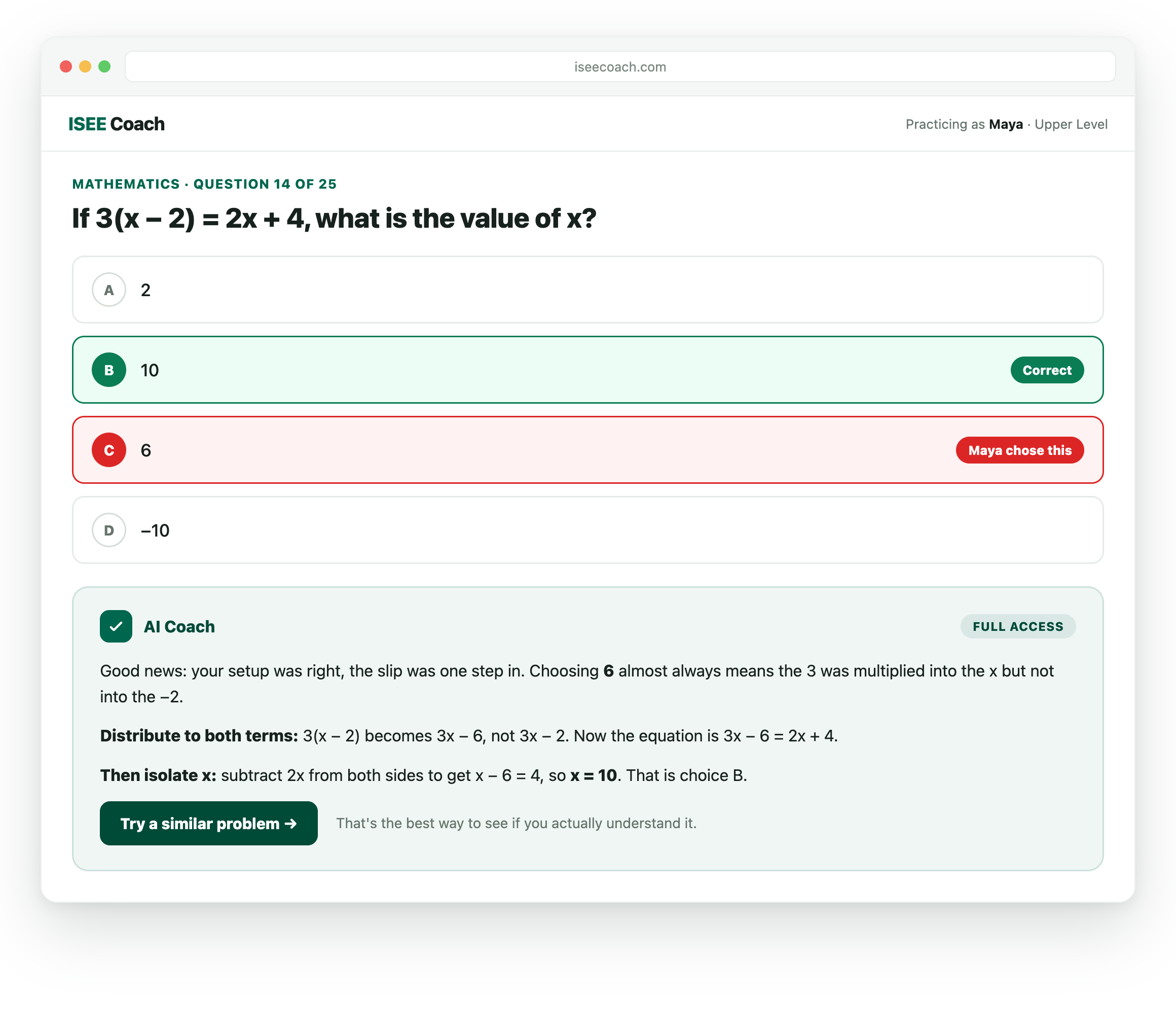
When your child misses a question, ISEE Coach walks through the likely mistake step by step. The free plan includes five ISEE Coach explanations. Full Access ($149 for 90 days, no auto-renewal) includes unlimited walkthroughs and a similar problem after each miss, so your child can check right away that the idea has stuck.
For the full picture of each level, see the Middle Level guide and the Upper Level guide.
No. The Lower Level Quantitative Reasoning section is word problems only. Quantitative comparisons appear at the Middle and Upper Levels, in the second part of Quantitative Reasoning.
Only when the information is incomplete, such as a total cost without the price of each item. If both columns are plain numbers, each has one exact value, so the answer is A, B, or C.
Usually not. You only need to know which quantity is greater. Simplifying both columns, ignoring a shared part, or estimating is often faster than finding exact values, and no calculator is allowed.
ERB's What to Expect guides list 14 to 17 quantitative comparisons out of the 37 Quantitative Reasoning questions at the Middle and Upper Levels. The rest are word problems.
Yes. The ISEE has no penalty for wrong answers, so a blank and a wrong answer both score zero. If time is short, your child should pick an answer, mark the question, and come back if time allows.
Start with a free 15-minute starter set, no sign-up needed. Then take a full-length, timed ISEE diagnostic at the Lower, Middle, or Upper Level and get a report on which subskills need work.
Try the free starter setNo credit card. No auto-renewal. Try a 15-minute starter set with no sign-up, then take a full diagnostic free.
More ISEE guides: ISEE scores · ISEE timing and pacing · ISEE essay · ISEE vs SSAT · ISEE study plan · Sentence completions · ISEE synonyms · Free ISEE practice test · Lower Level guide · Middle Level guide · Upper Level guide